Introduction
The transition toward Net Zero is rapidly reshaping industrial operations. While much of the focus remains on energy systems, electrification, and large-scale infrastructure, a significant and often overlooked opportunity lies within existing operations – specifically in how industrial fluids and lubrication are managed.
At the same time, regulatory and reporting pressure is increasing. Frameworks such as the EU Green Deal and the Corporate Sustainability Reporting Directive (CSRD) are pushing companies to measure and disclose emissions across Scope 1-3 categories with increasing accuracy. As highlighted by organizations such as the International Energy Agency (IEA), improving operational efficiency remains one of the fastest and most cost-effective pathways to emission reduction; yet it is often underexploited in industrial environments.
Lubrication sits in a unique position within this context. It directly influences asset reliability, operational efficiency, and emissions, yet it is still widely treated as a routine maintenance activity rather than a strategic lever. In practice, this means that one of the few domains capable of simultaneously reducing costs, improving uptime, and lowering emissions remains underutilized.
A shift is now underway. Forward-looking organizations are beginning to recognize lubrication not as a consumable, but as a controllable and optimizable asset, forming the foundation of what is increasingly referred to as Net Zero Lubrication.
From Time-Based Maintenance to Lifecycle Thinking
For decades, lubrication management has been built on time-based maintenance models. Oils are changed at predefined intervals, sampling is conducted periodically, and decisions are often based on incomplete or delayed information. While this approach has ensured a basic level of reliability, it has also led to systemic inefficiencies.
Industry experience suggests that a significant share of lubrication-related maintenance is either premature or reactive. Oils are frequently replaced before their actual end-of-life, while issues such as contamination or additive depletion are detected only after performance has already been affected.
A key limitation of this model is not the lack of data, but the lack of structure. Laboratory results, operational data, and maintenance records often exist in isolation. Without integration, their combined value remains largely unrealized.
The transition now underway reflects a broader shift in reliability engineering: from fixed schedules toward condition-based and system-level optimization. Instead of focusing only on maintenance intervals, organizations are increasingly managing the full lifecycle of fluids – from planning and usage to recovery and reporting.
Lubrication as a Driver of Net Zero Outcomes
Lubrication is one of the few industrial domains with a direct impact on both operational and environmental performance. Extending oil life reduces the need for production, transportation, and disposal of lubricants – key contributors to Scope 3 emissions; while improved fluid condition enhances machine efficiency and reduces energy losses.
From a lifecycle perspective, lubrication influences emissions across all major categories: direct operational emissions, energy consumption, and upstream and downstream lubricant lifecycle activities.
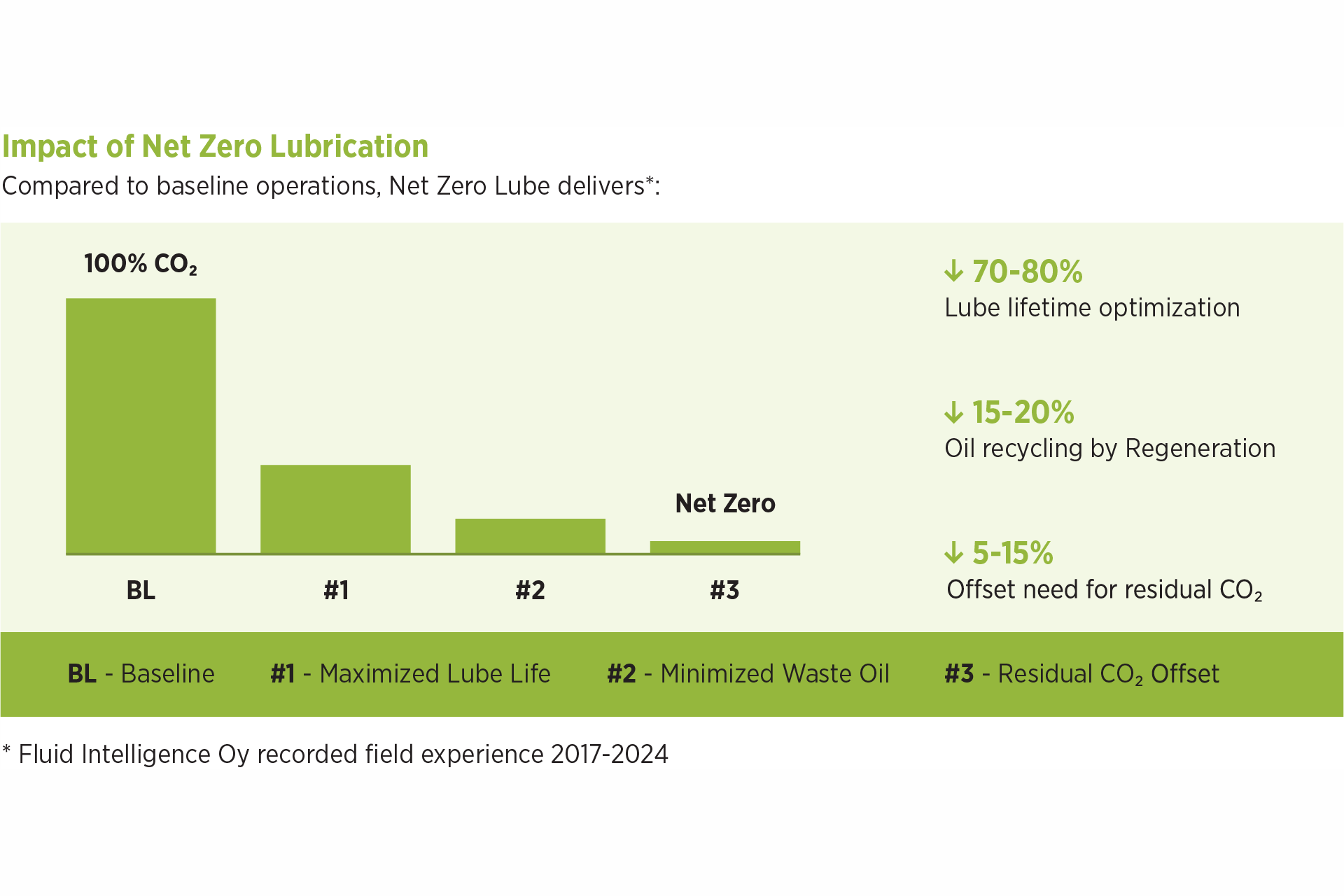
Field data indicate that most lubrication-related emissions are not fixed, but driven by operational practices. Optimized lubrication – core to a Net Zero Lubrication approach; can reduce emissions over 80% through extended oil lifetime and reduced waste streams.
This creates a clear opportunity: improving lubrication practices offers one of the fastest and most cost-effective pathways toward measurable Net Zero progress – without requiring major capital investments.
This aligns with broader industry analyses (e.g. McKinsey), which highlight operational efficiency and maintenance optimization as key, yet often underutilized, levers in industrial decarbonization.
A Practical Roadmap: From Insight to Impact
Achieving these outcomes does not require a single breakthrough technology. Instead, it requires a structured and repeatable approach that connects planning, operations, and lifecycle management into one continuous system – an approach increasingly aligned with Net Zero Lubrication principles.
The first step begins before the operation. By combining historical data, asset information, and simulation tools, organizations can model lubrication performance, risks, and emissions in advance. At the same time, this enables the definition of an optimal lubrication strategy before implementation; aligning technical decisions with operational, financial, and sustainability targets from the outset.
During operation, continuous visibility becomes critical. Real-time monitoring, supported by laboratory diagnostics, provides an ongoing view of fluid condition and machine health. In addition, performance can be actively maintained through filtration, contamination control, additive optimization, and the use of advanced lubricants such as fully synthetic or bio-based oils. Selecting the right combination – both initially and dynamically as conditions evolve, enables significant gains in lifetime, efficiency, and reliability.
The final step extends beyond operation. Instead of treating used oil as waste, organizations are increasingly adopting circular approaches that include regeneration, reuse, and structured end-of-life decisions. These actions can further reduce emissions by an additional 15 - 20%, complementing the initial optimization impact. The remaining 5 - 15% of residual emissions can be addressed, where necessary, through verified offset mechanisms such as environmental attribute certificates.
At the same time, automated reporting enables transparent tracking of cost, reliability, and emissions across assets; supporting compliance with ESG and CSRD requirements. This closes the loop and transforms lubrication into a measurable and auditable component of sustainability performance.
From Data to Decisions
Digitalization plays a central role in enabling this transformation – but only when data is converted into action. Many organizations already collect large volumes of data, yet struggle to extract consistent value from it.
The challenge is not access to data, but its usability. Data must be structured, contextualized, and translated into decisions by integrating laboratory results, sensor data, and operational history into a unified framework that supports analysis at both asset and fleet levels.
When this is achieved, data enables condition-based decision-making, benchmarking across fleets, and automated identification of risks and optimization opportunities. However, the foundation remains unchanged: the quality of the output is directly dependent on the quality of the input. Poor or fragmented data inevitably leads to poor conclusions.
Evidence from Industrial Applications
Lifecycle-based lubrication management is no longer theoretical. Across industries, organizations have achieved measurable improvements in reliability, cost efficiency, and emissions.
For example, continuous monitoring of a remote gas engine enabled a transition from periodic sampling to real-time condition awareness. This led to significantly extended oil lifetime, reduced maintenance effort, and improved operational stability; while simultaneously reducing emissions and costs.
In another industrial application, a systematic lifecycle approach in a large hydraulic system combining optimization, monitoring, and regeneration enabled emission reductions exceeding 80%, demonstrating the full potential of a Net Zero Lubrication model in practice.
These results reflect a broader trend: predictive and condition-based approaches consistently outperform reactive models in both cost and reliability.
Expanding the Scope: Toward Full Fluid Lifecycle Management
While lubrication is the natural starting point, similar principles apply to other industrial fluids.
Fuels can be optimized through monitoring, additives, and quality control, improving combustion efficiency and reducing emissions. Process fluids directly influence production quality and operational stability. Cooling fluids, in turn, play a critical role in thermal management and system performance.
Together, these form the basis of Industrial Fluid Lifecycle Management, where lubricants, fuels, coolants, and process fluids are managed as interconnected elements of a single system. Even in cases where certain fluids remain consumables, such as fuels – efficiency improvements of 5 - 10% can deliver meaningful cost and emission reductions, while other fluids’ lifetimes can be extended considerably through proper monitoring and control.
This system-level perspective reflects a broader industrial shift: from siloed optimization toward integrated performance management.
The Future: Toward Autonomous Optimization
Looking ahead, the evolution of fluid management is moving toward increasing levels of automation – from reactive maintenance to predictive, prescriptive, and ultimately autonomous systems.
Advances in AI, sensor technologies, and industrial data platforms are enabling continuous analysis of fluid performance at a level of granularity that was not previously possible. In future operating environments, optimization actions will be increasingly automated, reducing reliance on manual intervention and enabling faster response to emerging issues.
At the same time, reporting will become fully integrated into operational workflows. This is particularly relevant in the context of ESG and CSRD requirements, where companies must provide consistent, auditable data on emissions and performance across their operations.
Conclusion
The path to Net Zero is not only built on large-scale transformations, but also on improving how existing systems are operated.
Lubrication represents a clear and immediate opportunity. By shifting from time-based maintenance to lifecycle optimization – and toward Net Zero Lubrication - organizations can reduce emissions, lower costs, and improve reliability simultaneously at scale.
The broader implication is simple:
Net Zero is not only about replacing systems, but about running them better.
The required shift is fundamental:
From replacing fluids, to managing their performance.
Organizations that move early will not only meet regulatory demands but also build a more efficient and resilient operational foundation.
About the Author
Mika Perttula is CEO & Co-founder of Fluid Intelligence Oy, specializing in data-driven lubrication and industrial fluid lifecycle optimization. He is a recognized advocate of Net Zero Lubrication, focusing on reducing emissions, improving reliability, and extending asset life.
Mr. Mika Perttula
CEO & Co-founder | Fluid Intelligence Oy | Finland