Introduction
In the oil and gas industry, reliability is often discussed in the context of maintenance strategies, equipment failures, and plant uptime. While these aspects are undoubtedly important, the true foundation of reliability is laid much earlier, during technology selection, system architecture development, detailed engineering, and lifecycle planning.
As plants become increasingly automated and digitally connected, instrumentation and control systems have evolved from support functions into mission-critical assets. A single failure in a control system, safety instrumented system, communication network, or field instrumentation can lead to production losses worth millions of dollars, compromise safety, and disrupt business continuity.
The industry therefore needs to view reliability not as a maintenance function alone, but as a lifecycle discipline that begins at the concept stage and continues throughout the operational life of the plant.
Reliability Means Availability
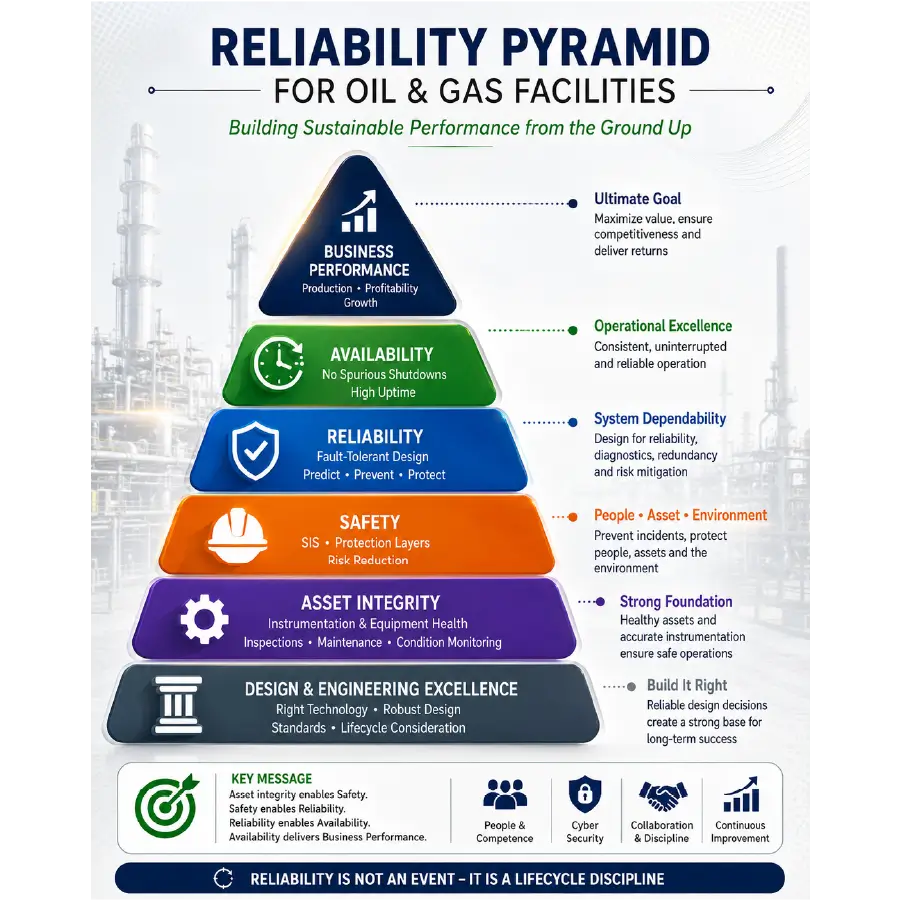
In oil and gas facilities, the ultimate business objective is sustained production without compromising safety. Therefore, the most meaningful measure of reliability is availability.
A system may be safe and technically compliant, yet still cause significant production losses through unnecessary shutdowns, spurious trips, or poor fault tolerance. Reliability engineering must therefore focus on achieving the optimum balance between:
- Safety
- Availability
- Cost
Excessive conservatism in design can be as damaging as insufficient protection. The challenge lies in designing systems that protect people and assets without unnecessarily sacrificing production.
The Importance of Fault-Tolerant Design
One of the most overlooked aspects of reliability is fault tolerance.
Many systems incorporate redundancy at controller, communication, and power supply levels, but hidden single points of failure often remain within interfaces, I/O architectures, communication paths, and field devices. These weaknesses only become apparent when a single component failure causes an unexpected plant trip.
A truly reliable design asks a simple question:
"Can a single instrumentation component failure interrupt plant operation?"
If the answer is yes, the design requires further optimization.
Fault-tolerant studies conducted during detailed engineering can identify redundancy breaks, non-redundant signal paths, vulnerable interfaces, and inadequate fallback strategies long before the plant is commissioned. The cost of addressing such issues during engineering is insignificant compared to the cost of correcting them after startup.
Balancing Safety and Availability
Safety and availability are often treated as opposing objectives. The most successful oil and gas facilities achieve both.
For example, modern Safety Instrumented Functions (SIFs) frequently employ 1oo2, 2oo2D, or 2oo3 architectures to improve diagnostic coverage and reduce dangerous failures. However, the same architectures can introduce increased spurious trip frequency if not designed carefully.
The objective should not be to maximize redundancy indiscriminately, but to optimize it based on risk and consequence analysis.
Every redundancy decision should answer three questions:
- What risk is being mitigated?
- What availability improvement is expected?
- Is the investment justified by the business consequence of failure?
This risk-based approach allows organizations to achieve both safety integrity and operational continuity.
Technology Adoption Must Pass the Reliability Test
The history of automation technology offers valuable lessons.
Several technologies entered the market with compelling value propositions like reduced wiring, advanced diagnostics, greater connectivity, and lower installation costs. Yet many struggled to achieve widespread long-term acceptance in critical process industries because reliability expectations were not fully met.
The oil and gas industry operates under unique conditions:
- Continuous operation
- High consequence of failure
- Long asset life cycles
- Limited shutdown opportunities
In such environments, reliability must remain the primary criterion for technology adoption.
New technologies should not be evaluated solely on functionality or cost savings. They must be assessed for maintainability, fault tolerance, lifecycle support requirements, cybersecurity implications, and operational robustness.
The most successful technologies are not always those with the most features; they are the ones that consistently deliver dependable performance over decades of operation.
The Emerging Reliability Challenge: IT-OT Convergence
The increasing integration of Information Technology (IT) and Operational Technology (OT) presents both opportunities and challenges.
Modern control systems benefit from enhanced connectivity, analytics, data integration, and user-friendly interfaces. However, these advantages introduce new reliability concerns:
- Cybersecurity vulnerabilities
- Frequent patch requirements
- Software compatibility issues
- Short hardware refresh cycles
- Obsolescence management challenges
Unlike enterprise IT systems, oil and gas control systems are expected to operate continuously for 15-20 years or longer.
This creates a fundamental challenge: how can organizations benefit from modern digital technologies without compromising the long-term reliability expectations of OT environments?
The answer lies in adopting architectures that prioritize operational continuity, lifecycle sustainability, cybersecurity, and maintainability from the outset.
Reliability Across the Entire Lifecycle
True reliability is achieved only when it is considered at every stage of the system lifecycle:
- Concept and Selection: Selecting the correct technology and architecture.
- Design and Engineering: Implementing redundancy, fault tolerance, maintainability, and cybersecurity.
- Testing and Factory Acceptance: Verifying functionality under realistic operating conditions.
- Commissioning: Ensuring systems perform as intended before startup.
- Operation and Maintenance: Maintaining performance through proactive monitoring and disciplined maintenance practices.
- Upgrades and Lifecycle Support: Managing obsolescence while minimizing operational disruption.
Reliability is therefore not an event; it is a continuous process extending from project conception to system retirement.
The Way Forward
The oil and gas industry is entering an era of digital transformation, artificial intelligence, advanced analytics, open architectures, and increasing connectivity. These developments offer enormous opportunities for improved efficiency and operational excellence.
However, one principle remains unchanged:
Reliability must remain the bottom line.
Every design decision, technology adoption initiative, cybersecurity strategy, and modernization project should ultimately be evaluated through the lens of reliability and availability.
Organizations that successfully embed reliability into their engineering culture, not merely into their maintenance programs, will achieve safer operations, higher production availability, lower lifecycle costs, and stronger business performance.
In the end, reliability is not simply about preventing failures.
It is about enabling sustained business success.
About the Author
Dr. Kartik Fojdar is an electronics engineer and Senior Vice President & Head of the Center of Excellence (CoE) – Instrumentation at Reliance Industries Ltd. With over 39 years at Reliance, he has led initiatives across instrumentation, plant maintenance, engineering services, and asset reliability. He has also contributed extensively to Process Safety Management (PSM), competency development, and business systems, and is a respected author and speaker.
Dr. Kartik Fojdar
Sr. Vice President | Reliance Industries Ltd. | India