The Overlooked Carbon Lever
A lot of decarbonization plans begin with furnaces, compressors, motors, and power bills. Very few begin by looking at the oil reservoir. That is odd, because lubricants sit right at the intersection of energy efficiency, reliability, waste generation, and circularity. The world uses on the order of 35 million tonnes of lubricants annually, and a large share is ultimately lost through combustion, leakage, evaporation, residue, or disposal rather than being cleanly recovered. The U.S. Department of Energy treats energy efficiency as a foundational industrial decarbonization strategy, and ISO/API life-cycle guidance makes clear that lubricants must be evaluated across their full life, not just at the point of purchase. In plain language, the oil reservoir is not a maintenance headache. It is part of the emissions system.
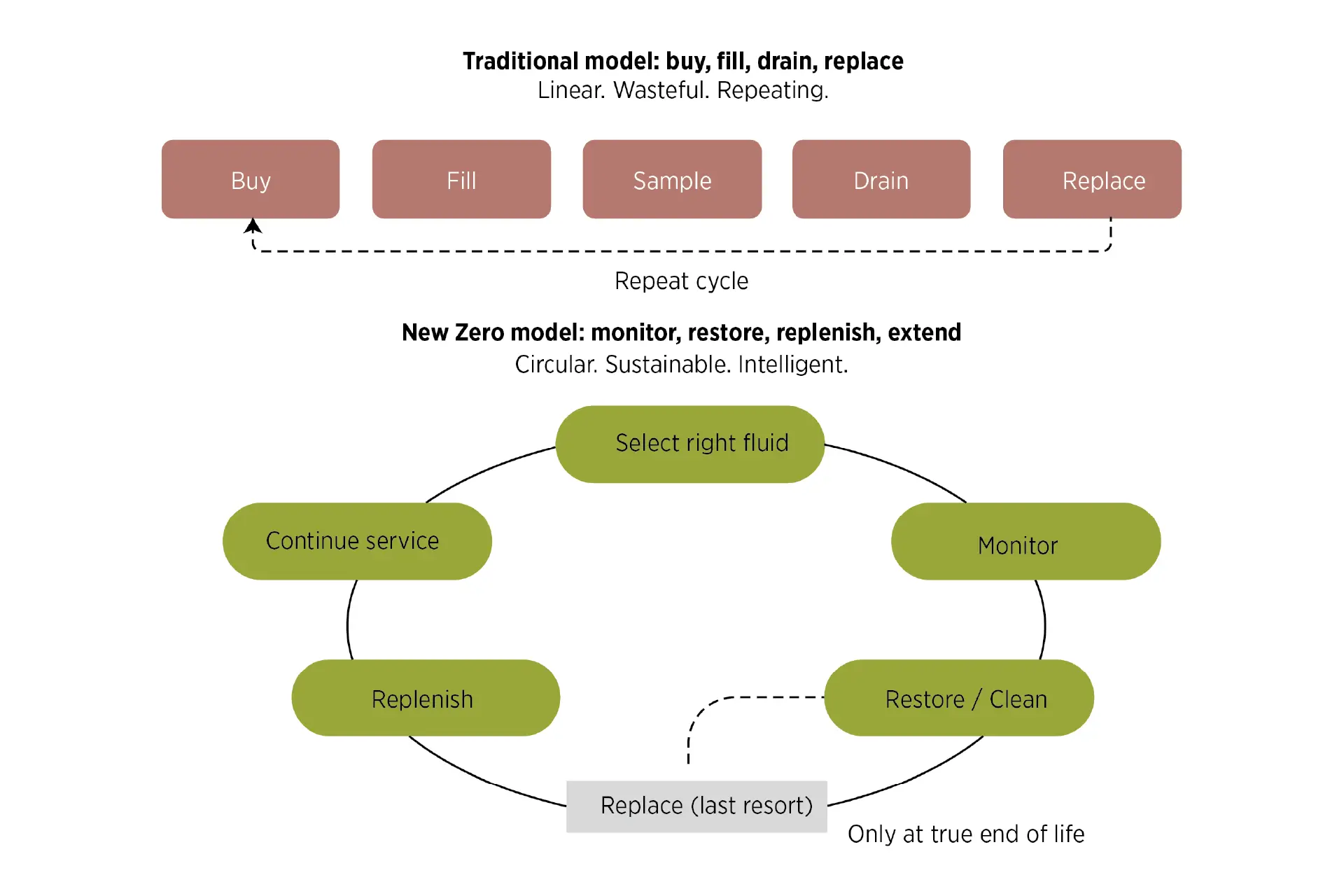
Yet industrial lubrication is still managed too often like a consumable. Buy it, fill it, sample it, drain it, replace it. Repeat. The real climate question is not simply, “What is the carbon footprint of a fresh drum?” The real question is, “What is the carbon footprint of the lubrication strategy over the service life of the machine?” A lubricant’s sustainability can only be judged on a cradle-to-grave basis, because product use and end-of-life effects can far outweigh cradle-to-gate manufacturing impacts. API Technical Report 1533 reaches the same conclusion and explicitly distinguishes a lubricant’s product footprint from the avoided emissions created by longer drain intervals or better in-use efficiency.
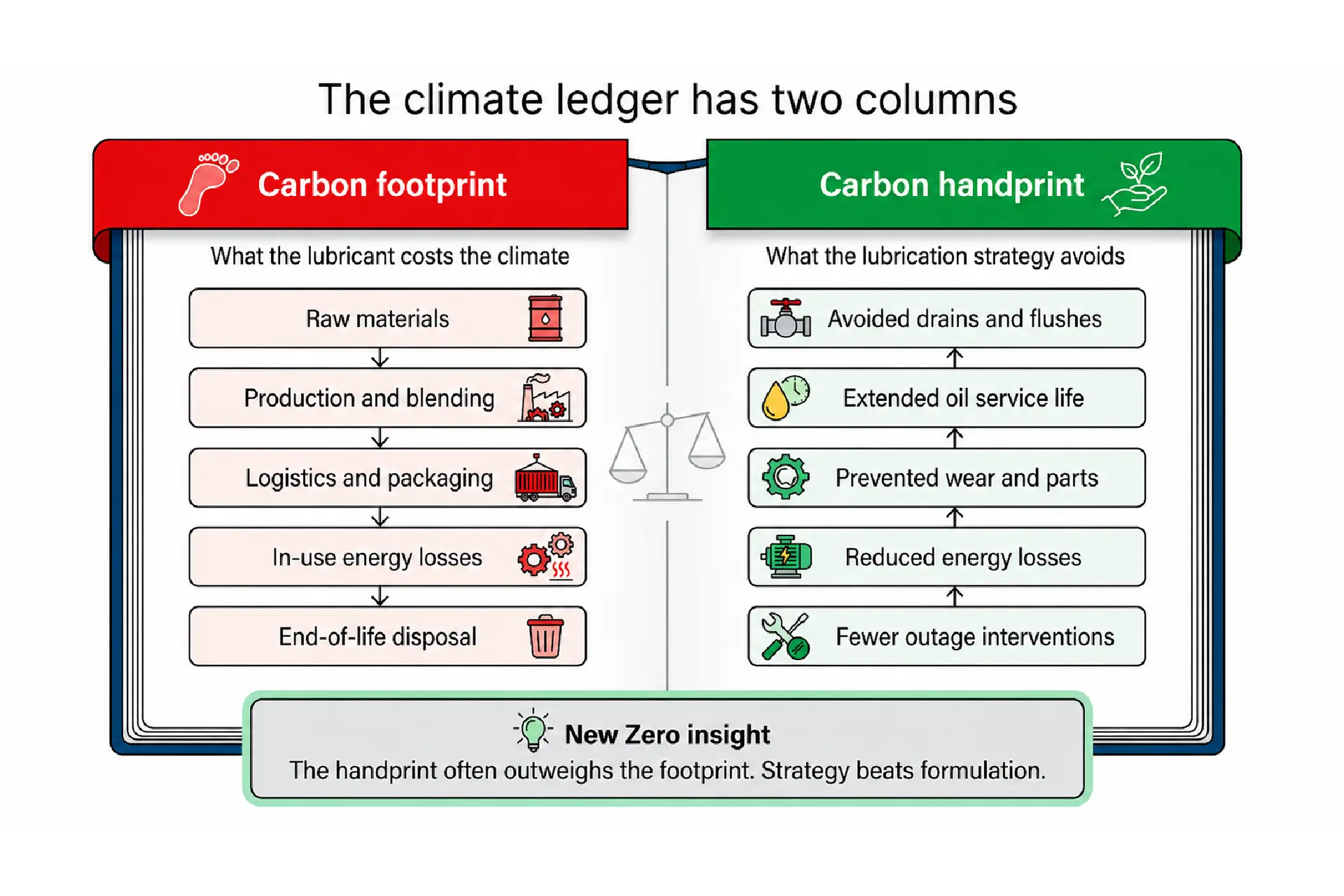
A skeptical maintenance manager may ask whether this is really a decarbonization story or simply a cost story dressed up in greener language. The honest answer is that it is both. The DOE’s industrial decarbonization roadmap treats energy efficiency as foundational because the lowest-carbon energy is the energy a plant never needs to use. Lubrication works the same way, and as the oil deteriorates in service, increased friction, hotter-running bearings, more oil changes, replacement parts, and unplanned interventions all increase emissions because they increase resource use. Life Cycle Assessment is sustainability’s version of total cost of ownership. It tells you whether a cheaper decision is only cheaper on purchase-order day, or genuinely better over the life of the asset.
The Tribology Evidence
Tribology literature has been telling us this for years. Holmberg and Erdemir estimated that roughly 23% of global energy consumption is associated with tribological contacts, about 20% to overcome friction, and a further 3% to remanufacture parts and equipment lost to wear. Woydt later pushed the point further, arguing that wear protection and condition monitoring deserve to be treated as climate technologies because they reduce the material and energy burden tied to failure, replacement, and shortened asset life. Once you see lubrication through that lens, additive replenishment and fluid enhancement stop looking like a niche maintenance tactic. It starts to look like a serious decarbonization lever.
The 98/2 Leverage Point
Why such leverage? Because in many industrial oils, the part that fails first is not the bulk base oil. It is a very small amount of additive chemistry. Turbine oils are typically 98% - 99% base stock and only about 1% - 2% additive, yet that sliver of additive, especially the antioxidants, largely determines oxidation life and deposit control. Earlier lubricant LCA work points out an interesting nuance: antioxidants can carry roughly twice the carbon footprint of mineral base oil on a per-kilogram basis, but they represent only a tiny percentage of the formulation. That is exactly the kind of leverage decarbonization teams should like. A small quantity of chemistry, added intelligently, can preserve thousands of liters of serviceable base oil.
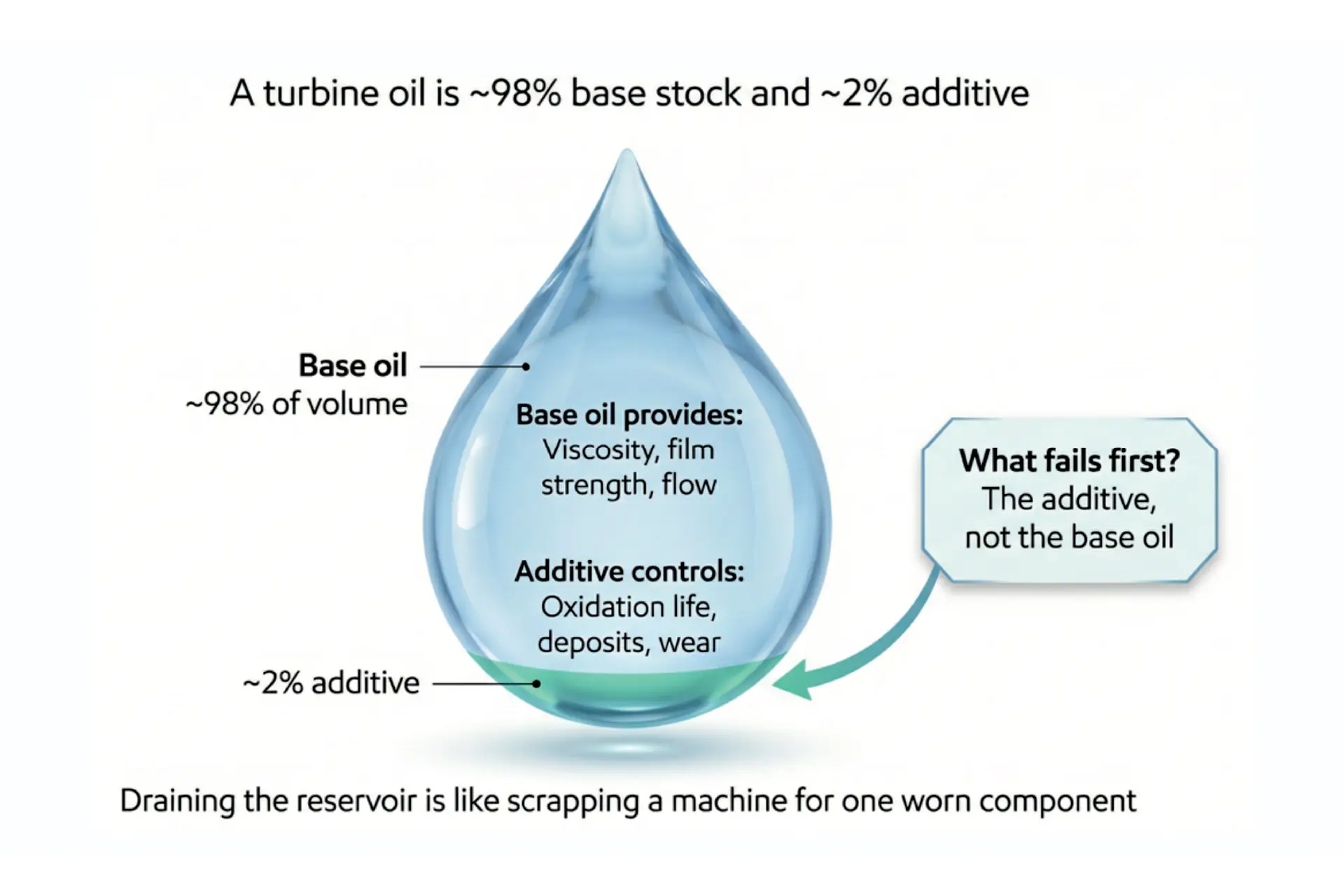
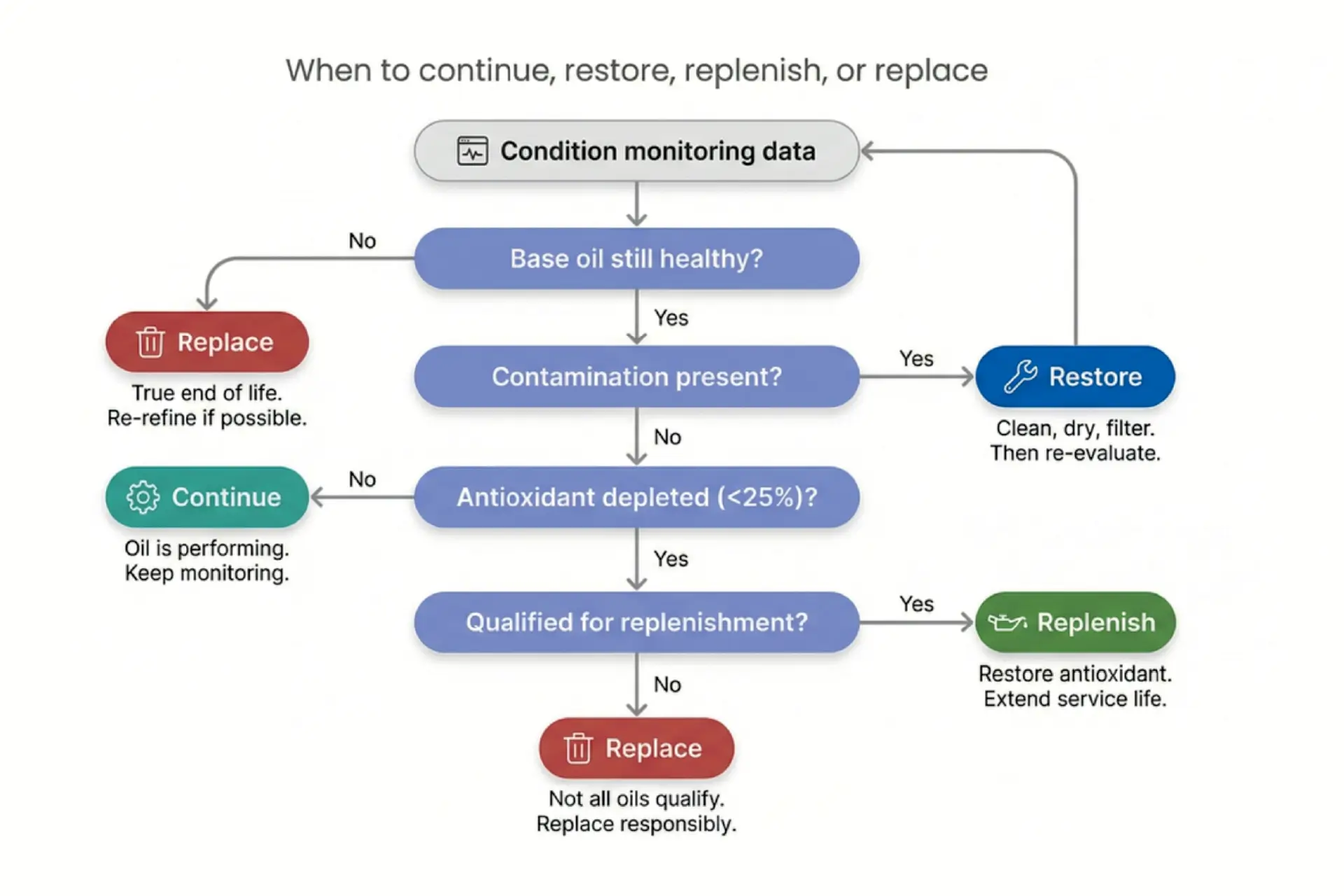
In oxidation-dominated systems such as turbine and some compressor oils, the failure path is familiar. Antioxidants deplete. Oxidation by-products accumulate. Varnish potential rises. Then the physical symptoms start showing up where operators actually feel them: sticking valves, hot bearings, poorer heat transfer, reduced oil flow, and lower reliability. The condemning threshold for many rust and oxidation-inhibited lubricants is 25% of the original antioxidant capacity. The critical point is what follows from that observation. When the oil is kept clean and dry, and degradation products are controlled, the base oil may still be fundamentally healthy when the antioxidant system is no longer adequate. Draining the whole reservoir at that moment is like scrapping a machine because one wearable component is spent.
Additive Replenishment and Fluid Enhancement Done Right
That does not mean every lubricant should be topped up with an additive and sent back into service. Or the performance of every in-service lubricant is enhanced by adding a solubility enhancer to manage deposits. Done casually, additive replenishment is a bad idea. Suppliers are right to be cautious about indiscriminate top-treating. No two oils are identical, even inside the same application class. The replenishment chemistry has to match the original antioxidant system, avoid upsetting the balance of the formulation, and be verified for compatibility and long-term behavior. Each reservoir should be qualified independently, and laboratory testing should come first.
Turbine oil qualification and accelerated-aging programs are typically supported by standardized performance testing, while in-service monitoring draws on a combination of antioxidant reserve measurement, oxidation stability testing, varnish potential assessment, and routine condition monitoring data. Together, these approaches connect formulation chemistry to operational maintenance decisions.
Proof Point: 200,000 Hours and Counting
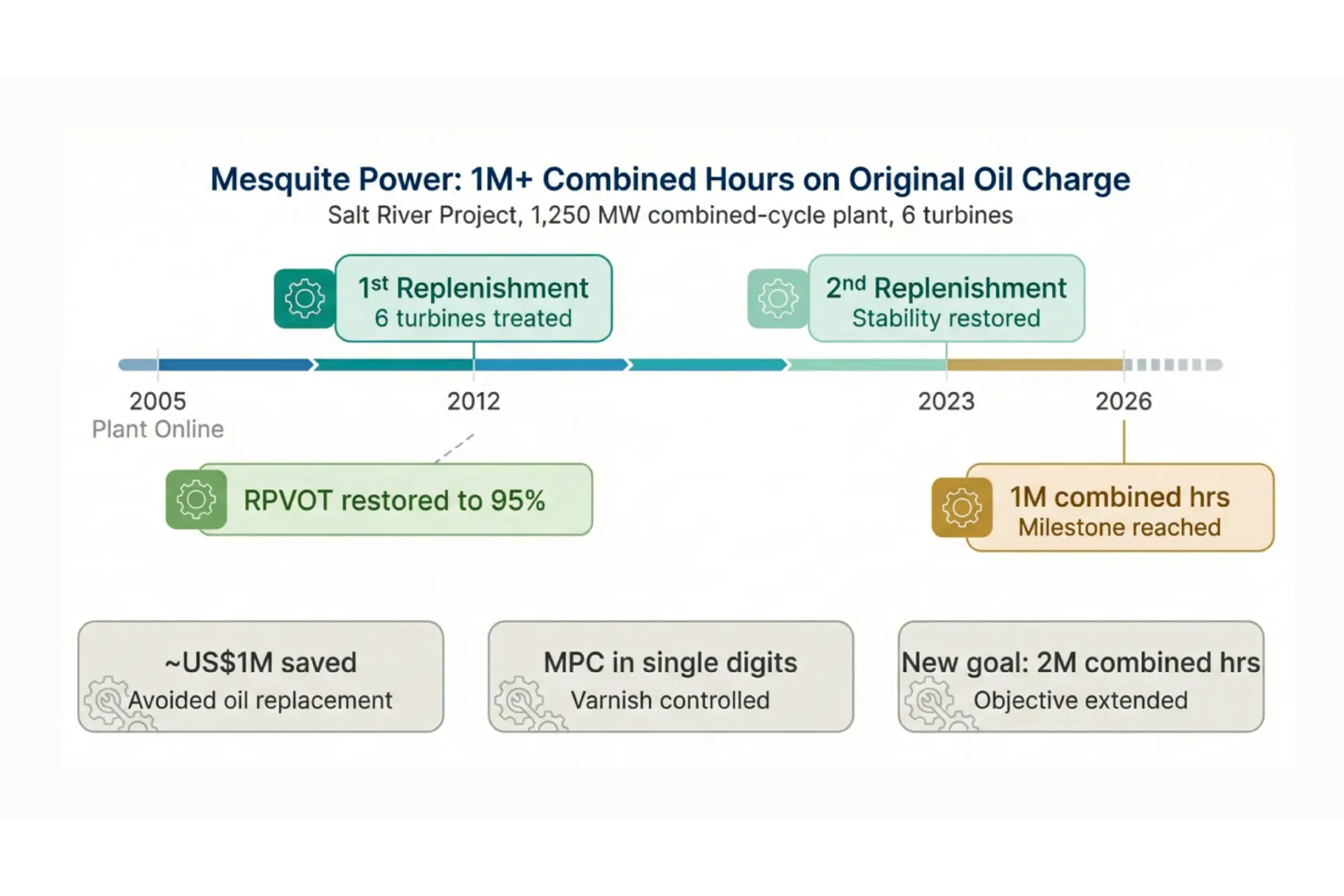
The Mesquite Power Generation case remains one of the clearest proof points in the industry. At Salt River Project’s 1,250 MW Mesquite combined-cycle plant, qualification testing showed the 8-year-old, in-service oil was suitable for antioxidant replenishment. In 2012, each of the four gas turbines and two steam turbines was replenished with antioxidants. RPVOT values were restored to within 95% of new oil, and MPC values were maintained in single digits. In 2023, all six turbines were replenished again, restoring oxidation stability to new oil levels.
The plant estimated roughly US$1 million in avoided costs by not replacing the turbine oil and flushing six turbines. When the additive replenishment program began in 2012, the power plant's objective was to reach more than one million combined operating hours on the original charge of oil across all six assets. For large-frame gas turbines, this is virtually unheard of. The plant has now passed this milestone and reset its objective to two million operating hours. Considering the design parameters of large-frame gas turbines, the oil is expected to meet the full service life of these machines, effectively meaning the original charge was fill-for-life. This is not only a different maintenance model, but a different carbon model as well. The Mesquite case study is summarized in Fig. 4.
The Climate Math
The climate case is just as compelling as the maintenance case. Avoiding a varnish flush in a 20,000-liter gas turbine could avoid roughly 18 metric tons of CO2e per year. The lesson is broader than any one chemistry or any one supplier. Every avoided drain, flush, packaging cycle, tanker movement, disposal pathway, outage intervention, and replacement part carries carbon. API’s LCA guidance formally recognizes this by allowing avoided-emissions calculations for longer oil drain intervals and in-use efficiency benefits. Once plants start accounting that way, the greenest oil is often not the oil with the prettiest cradle-to-gate number. It is the lubrication strategy that delivers the lowest life-cycle burden per year of reliable service.
Fill-for-life lubricants are also about resilience in a changing world. Against the backdrop of today's geopolitical turbulence, from the Gulf to wider supply chain disruptions, the old habit of simply buying and replacing oil, without actively minimising waste, is no longer a responsible way to operate. Every litre we avoid consuming is a litre less exposed to price shocks, trade restrictions, and logistical fragility. Fill-for-life reframes lubricant management as a strategic hedge: lower waste, longer oil life, and a more resilient operation in a world where resource security can no longer be taken for granted.
The Roadmap to New Zero
This is why additive replenishment and fluid enhancement belongs inside the industrial lubricant roadmap to New Zero, not off to the side as a specialty activity. A credible roadmap starts with selecting the right fluid for the duty cycle. Then it moves to contamination control, storage and handling discipline, condition monitoring, varnish mitigation, and a deliberate decision framework for when to continue, when to restore, when to replenish, and when to replace.
Re-refining still matters at true end of life, and published LCAs on re-refined base oils show why circularity deserves a place in the conversation. But re-refining should be the last move, not the default move. The first question should always be whether the lubricant can continue performing safely with restoration and enhancement. That is both a better carbon hierarchy and a better economic model.
Starting in the Reservoir
The road to New Zero will not be built by slogans, offsets, or one-time procurement choices. It will be built by disciplined operating decisions inside plants, one system at a time. For industrial lubrication, one of the smartest of those decisions is to stop treating good base oil as disposable simply because a small fraction of the additive has been sacrificed in service.
Additive replenishment will not apply everywhere, and it should never be used without qualification, monitoring, and formulation expertise. But in the right applications, it does something very few decarbonization measures manage to do at once: it reduces waste, lowers embodied carbon, improves reliability, increases resilience, and saves money.
The New Zero may not start in the boardroom. It may start in the reservoir.
References
[1] International Organization for Standardization. ISO 14040:2006/Amd 1:2020, Environmental management — Life cycle assessment — Principles and framework; and ISO 14044:2006, Environmental management — Life cycle assessment — Requirements and guidelines.
[2] American Petroleum Institute. API Technical Report 1533: Lubricants Life Cycle Assessment and Carbon Footprinting—Methodology and Best Practice. 1st ed., 2023.
[3] Livingstone, G. The Drive Towards Lubricant Decarbonization. Precision Lubrication Magazine. December, 2022.
[4] Livingstone, G. Measuring and Attaining Sustainable Lubrication. Precision Lubrication Magazine. February, 2023.
[5] Livingstone, G.; Mathura, S. Energy Efficiency: The Critical Step Towards Sustainable Lubrication. Precision Lubrication Magazine. 2023.
[6] Livingstone, G.; Joy, M. "Long-Term Results of Turbine Oil Antioxidant Replenishment at a Combined Cycle Power Plant." OilDoc Conference Proceedings, Rosenheim, Germany, 2017.
[7] Raimondi, A.; Girotti, G.; Blengini, G. A.; Fino, D. "LCA of petroleum-based lubricants: state of art and inclusion of additives." The International Journal of Life Cycle Assessment 17 (2012): 987–996. DOI: 10.1007/s11367-012-0437-4.
[8] U.S. Department of Energy. Industrial Decarbonization Roadmap. September 2022.
[9] Holmberg, K.; Erdemir, A. "Influence of tribology on global energy consumption, costs and emissions." Friction 5, no. 3 (2017): 263–284. DOI: 10.1007/s40544-017-0183-5.
[10] Holmberg, K.; Erdemir, A. "The impact of tribology on energy use and CO₂ emission globally and in combustion engine and electric cars." Tribology International 135 (2019): 389–396. DOI: 10.1016/j.triboint.2019.03.024.
[11] Woydt, M. "The importance of tribology for reducing CO₂ emissions and for sustainability." Wear 474–475 (2021): 203768. DOI: 10.1016/j.wear.2021.203768.
[12] Woydt, M. "Material efficiency through wear protection — The contribution of tribology for reducing CO₂ emissions." Wear 488–489 (2022): 204134. DOI: 10.1016/j.wear.2021.204134.
[13] Grice, L. et al. "Life Cycle Carbon Footprint of Re-Refined versus Base Oil That Is Not Re-Refined." ACS Sustainable Chemistry & Engineering 2, no. 2 (2014): 158–164. DOI: 10.1021/sc400182k.
[14] Wang, W.; Qu, J. "Current and Candidate Additives for Environmentally Acceptable Lubricants—A Review." Friction 13 (2025): 9440988. DOI: 10.26599/FRICT.2025.9440988.
[15] The Climate Drive (WBCSD) / Solar Impulse Foundation. "Optimize Lubricant Application in Industrial Turbines." Action Library Case Study: SRP Mesquite Power Plant, Arlington, Arizona.
About the Authors
Greg Livingstone is Chief Innovation Officer at Fluitec, where he drives technology strategy and OEM partnerships across the company's lubricant life-extension portfolio. With three decades in rotating equipment reliability, his work focuses on the chemistry of lubricant degradation and the engineering of solutions that mitigate failure risk. He has co-developed oil analysis methods and patented filtration and additive replenishment technologies now deployed across power generation, petrochemical, and wind energy fleets globally. An active contributor to STLE, ICML, and ASTM, Greg has published over 100 technical papers and co-authored Turbomachinery Cholesterol: The Story of Varnish.
Mr. Greg Livingstone
Chief Innovation Officer | Fluitec | United States
Dr. Cristian Soto is Chief Operations Officer at Fluitec, where he leads R&D and technology strategy across the company's lubricant life-extension and condition monitoring portfolio. A chemist by training, Cristian has built his career on the intersection of fluid chemistry, asset reliability, and sustainability, translating rigorous science into deployable industrial solutions. At Fluitec, he directs product development across the DECON™ and SOLVANCER® platforms, advancing additive replenishment chemistry and circular-economy practices that extend oil life, reduce waste, and lower the carbon intensity of heavy industry. He is also a published co-author in peer-reviewed tribology research.
Dr. Cristian Soto
Chief Operations Officer | Fluitec | United States
Pierre Vanderkelen is CEO of Fluitec, leading the company's mission to extend equipment reliability and reduce industrial carbon intensity through advanced lubrication science. A Belgian-trained nuclear engineer, he developed his project-finance and technical foundation at ENGIE on nuclear and renewable assets before joining Fluitec in 2009. He launched the company's Singapore and Australia operations, then became CEO in 2017. Under his leadership, Fluitec has co-branded global lubrication solutions with ExxonMobil and is on pace to avoid 100 kt CO₂e and divert 20 million liters of base oil from disposal by 2030.
Mr. Pierre Vanderkelen
CEO | Fluitec | Netherlands